
Adult Attachment and the Social Construction of Regret: Revisiting High School Experiences



Audrey Horwitz & 2 others
September 22, 2026

Abstract
Purpose. Attachment theory has been applied to understanding interpersonal processes across the lifespan (Bowlby, 1988), including the experience of regret (Schoemann et al., 2012). Prior research has linked adult attachment to regret in close relationships, yet little is known about how attachment relates to adults’ retrospective evaluations of formative social contexts such as high school (HS). The present study examined adult attachment anxiety and avoidance correlations with satisfaction with HS, and whetherregret serves as a social–cognitive mechanism linking attachment to retrospective satisfaction. Method. Eighty-one adults completed self-report measures of adult attachment (ECR-S; Brennan et al., 1998), HS satisfaction (Casas et al., 2012), and regret (Regret & Disappointment Scale; Marcatto & Ferrante, 2008). Results. Correlational analyses indicated that attachment anxiety was positively associated with regret; attachment avoidance was not. Structural equation modeling revealed a full mediation model, such that attachment anxiety predicted greater regret, which in turn predicted lower satisfaction with HS. No direct pathway from attachment anxiety to satisfaction emerged when regret was included in the model. Discussion. Findings suggest that attachment anxiety, not avoidance, is linked to HS regret, which subsequently shapes satisfaction. Consistent with attachment-based emotion regulation models, individuals higher in attachment avoidance may be less likely to internalize responsibility for past outcomes, thereby attenuating regret (Mikulincer & Shaver, 2017). Implications for attachment theory and future research on retrospective social evaluation as well as clinical intervention are discussed.
Introduction
The High School Experience
HS is a crucial period of development in people’s lives, many being exposed to new opportunities, people, and concepts, all while experiencing both physical and mental growth. While some people enjoy HS, some students report dissatisfaction in HS (Çopur & Kökönyei, 2025), and report disappointment in their friendships, school performance, and relationships with teachers. Studies exploring regret have found that educational experiences are the most commonly regretted events and rank number one among the six most frequently reported regret domains. The education regrets described most include dropping out of school, not studying hard enough, or not obtaining a degree. (Morrison & Roese, 2011; Roese & Summerville, 2005). Although researchers have focused regrets and satisfaction of high school, few researchers have studied what factors relate to these regrets. One factor that may relate to HS regret is attachment style.
Attachment Styles, Satisfaction, & Regrets
According to attachment theory (Bowlby, 1988), sensitive caregiving early in life leads a child to develop a sense of attachment security. Unresponsive or insensitive caregiving, on the other hand, leads to an insecure attachment style (Bowlby, 1988). Insecure attachment is represented by two dimensions: attachment anxiety and avoidance. Individuals high on attachment anxiety tend to have a negative view of themselves and report lower levels of relationship satisfaction as compared with non-anxiously attached individuals. Individuals high on attachment avoidance tend to hold positive views of themselves, holding negative views of others, and externalizing blame for negative events (Bartholomew & Horowitz, 1991). Researchers have found that adults with more attachment anxiety have more overall regret because they are more focused on mistakes they have made and negative feelings, generally internalizing blame (Shoemann et al. 2012).
The Current Study Aim
Although prior studies found a relationship between attachment and regret in relationships, they have not studied regrets related to HS. The current study investigated the relationship between attachment, HS regrets, and HS satisfaction in adults, years after they completed HS.
Hypothesis One
A) Based on prior research (Shoemann et al., 212), we expected that attachment anxiety and avoidance would correlate to regrets in HS. The more attachment anxiety and avoidance, the more regrets in HS.
B) We also expected that attachment anxiety and avoidance would correlate with satisfaction in HS. The more attachment anxiety and avoidance, the less satisfied in HS.
Hypothesis Two
We also hypothesized that regret would mediate the relationship between attachment dimensions and satisfaction with HS.
Method
Participants
Eighty-One adults completed a survey in Qualtrics. The average age of participants was 51.39 (SD=14.30), ranging from 23 to 80 years. Participants were HS graduates (5%), college graduates (30%), Masters degree holders (40%), and Doctorate degree holders (25%).
Measures
Attachment Measure: The Experience in Close Relationships- Short From (ECR-S; Brennan, Clark, & Shaver, 1998) was used to assess Attachment Anxiety and Avoidance. The measure has 12 items rated on a Likert scale. Six items assess anxiety, and 6 items assess avoidance. In this study, internal consistency for attachment anxiety (α=.67) and attachment avoidance (α=.69) were found to be marginal.
Satisfaction: Satisfaction with HS was assessed using a 6-item about aspects of school life such as achievements in studies, the relationship with school peers, the relationship with teachers, and life as a student (Casas et al. 2012). The measure has 6 items rated on a Likert scale. In this study, internal consistency for HS Satisfaction (α=.87) was found to be acceptable.
Regret: The Regret and Disappointment Scale (RDS, Marcatto & Ferrante, 2008) was used to assess regret about HS. The measure has 7 items and was rated on a Likert scale and one multiple choice question as the 7th item. In this study, internal consistency for HS Regret (α=.91) was found to be acceptable.
Procedures
Participants were recruited between November 18, 2025, and November 29, 2025, and they completed an anonymous online survey.
Results
Hypothesis One
Regarding Hypothesis 1A, correlations revealed that attachment anxiety significantly positively correlated with HS regrets(see Table 1). The hypothesized correlation between attachment avoidance and regret was not supported.
Regarding Hypotheses 1B, correlations revealed that attachment anxiety significantly, negatively correlated with HS satisfaction (see Table 1). As attachment anxiety increased, satisfaction decreased. There was no significant correlation between Avoidance and Satisfaction.
Table 1. Correlations of Attachment, Satisfaction, and Regret
| Variables | n | M | SD | 1 | 2 | 3 | 4 | 5 |
|---|---|---|---|---|---|---|---|---|
| 1. Attachment Anxiety | 81 | 20.06 | 5.86 | 1 | .013 | -0.34** | 0.43** | 0.01 |
| 2. Attachment Avoidance | 81 | 15.73 | 5.22 | 1 | -0.18 | 0.18 | -0.01 | |
| 3. Satisfaction | 81 | 47.81 | 11.20 | 1 | -0.61** | -0.22* | ||
| 4. Regret | 81 | 9.22 | 4.91 | 1 | -0.04 | |||
| 5. Age | 81 | 51.39 | 14.30 | 1 |
Hypothesis Two
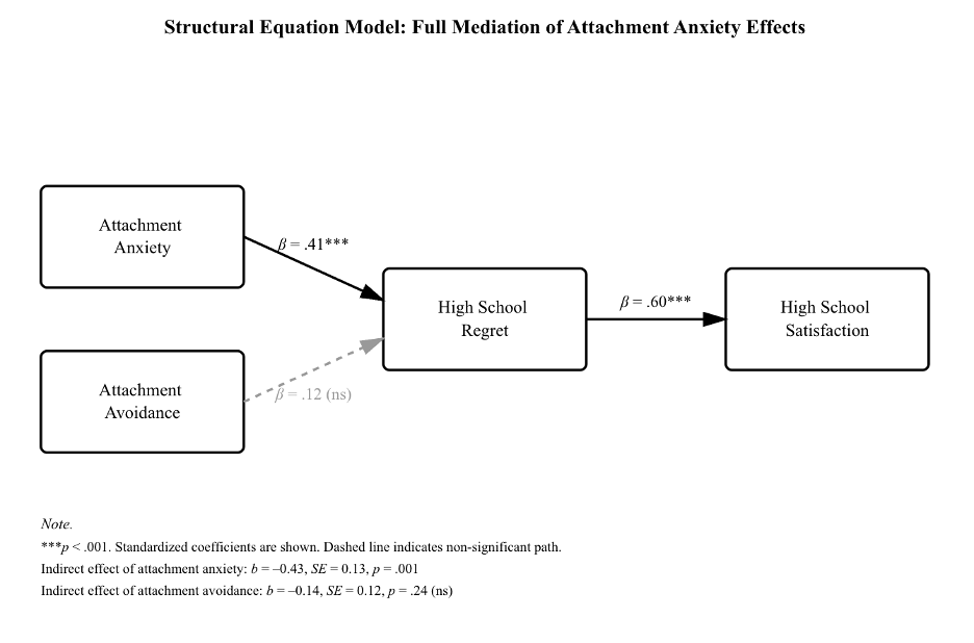
Structural Equation Modeling revealed a full mediation with only attachment Anxiety relating to Regret, and Regret then leading to Satisfaction (see Figure 1). Attachment Avoidance was not significant in the model. Attachment Anxiety did not directly relate to Satisfaction in the model. The only significant path to Satisfaction from Attachment Anxiety was through Regret. The full mediation model demonstrated excellent fit to the data, χ²(2) = 1.51, p = .47, RMSEA = .000 (90% CI [.000, .204]), CFI = 1.00, and TLI = 1.02.
Figure 1.
Discussion
Major Findings
As expected, attachment anxiety was related to regrets in HS while attachment avoidance was not related to regrets. This corresponds with previous research that found individuals with attachment avoidance tend to externalize blame (Mikulincer & Shaver, 2017). These findings are important to healthcare providers who may work with people who struggle with regret. Targeting attachment anxiety and helping people feel more confident in themselves may reduce regrets. The findings also demonstrate that regret was related to satisfaction in the high school experience. It is possible that reducing regret in people who are not satisfied in their HS experience may have a positive impact on their satisfaction with their memories of high school. Another finding revealed that there was a negative correlation between age and regret, meaning that as people’s age increases, regret about HS decreases. In essence, growing older, regardless of attachment, may lessen earlier regrets in life.
Limitations
Limitations include that the analysis is correlational, and the measures are self-reported by participants. In addition, the first author was not allowed to ask about race, ethnicity, or gender when collecting data from human participants due to regulations of Fairfax County Public Schools (FCPS), so it is unclear how diverse the sample is or how generalizable the findings are to diverse people. We also focused on memories of HS and memories may be distorted by current mood and age (Shahvaroughi, et al., 2025) We also do not know if memories are accurate and represent the experience during HS. Lastly, we only included three variables in the model and there may be other factors that are relevant to satisfaction in HS such as academic performance.
Future Directions
Future researchers could explore additional variables that relate to high school regret such as academic performance, sport achievements, and family struggles. These variables could have a potential impact on satisfaction with oneself during this stage of development. In future studies, one could replicate the current study with HS students to see if attachment anxiety and regret have the same impact on satisfaction in young people during HS rather than memories of high school. Future researchers could explore family attachments and traumas to see how that impacts attachment and interventions with HS students. Studies could explore the effectiveness of interventions with students who are not satisfied in HS or have insecure attachments to see if there is a way to help them have more positive memories and experiences.
Clinical Implications
Even though our study focused on poor satisfaction with high school, findings can be applied to many different past experiences such as college, employment, or even relationships. Based on our findings, people who come into counseling with less satisfaction and complaints about the past may benefit from the counselors asking about their regrets and even about their internal representation of themselves (to assess attachment anxiety). Counselors can then help their clients challenge negative self-perceptions as well as self-blame in the hope of reducing regret and increasing their clients’ satisfaction with the past. Appreciating how clients’ current attachment anxiety influences memories is important in mental health treatment because many psychotherapy treatments are effective at reducing attachment anxiety (Taylor, et al., 2015).
About the Authors
Audrey Horwitz
Audrey is a Sophomore at Falls Church High School who is interested in psychology and attachment theory.
Kelly Gleischman, MA
Kelly Gleischman serves as the Founder and Chief Executive Officer of KLG & Associates, a national consulting firm that focuses on all things people, from helping leaders create strong teams and cultures to creating systems for hiring, compensating, rewarding, and developing employees at every level. Prior to launching KLG & Associates, Kelly served as the Managing Partner (Chief Executive Officer) at EdFuel, a national talent management nonprofit focused on helping schools and nonprofits recruit and retain a talented and diverse staff. Prior to EdFuel, Kelly held roles in the education ecosystem that focused on charter authorizing, district partnerships, instructional leadership, and teaching. Kelly holds a Bachelor of Arts from Stanford University, a Master of Arts in Teaching from American University, and is currently a Doctoral Student in Clinical Psychology at The George Washington University. She splits her time between Washington D.C. and Austin, where you can often find her listening to psychology podcasts, writing, and exploring the local food scenes.
Cheri L. Marmarosh, Ph.D., ABPP, CGP
Cheri L. Marmarosh, Ph. D., is a Professor in the Professional Psychology Program at the George Washington University and a licensed psychologist who has been practicing in DC for over 30 years. She has published over 60 empirical and theoretical articles that focus on how group and individual psychotherapy facilitate change. Dr. Marmarosh is the lead author of two books, Attachment in Group Psychotherapy and Groups: Fostering a Culture of Change. She is the Editor of the book, Attachment in Group Psychotherapy, a monograph of manuscripts from the special edition the International Journal of Group Psychotherapy dedicated to attachment theory. She is a Fellow of Division 29 (Psychotherapy) and Division 49 (Group) of the APA. Dr. Marmarosh’s research applies attachment theory to understand the development of the psychotherapy relationship, and she has focused on how client and therapist attachments influence both the process and outcome of psychotherapy.
Citation
References
Bartholomew, K., & Horowitz, L. M. (1991). Attachment styles among young adults: a test of a four-category model. Journal of Personality and Social Psychology, 61(2), 226.
Bowlby, J. (1988). A secure base: Parent-child attachment and healthy human development. New York: Basic Books.
Brennan, K. A., Clark, C. L., & Shaver, P. R. (1998). Self-report measurement of adult attachment: An integrative overview. Attachment Theory and Close Relationships, 46(1), 70-100.
Casas, F., Sarriera, J. C., Alfaro, J., González, M., Malo, S., Bertran, I., Figuer, C., Abs, D.A. da Cruz, Bedin, L., Paradiso, A., Weinreich, K., & Valdenegro, B. (2012). Testing the personal wellbeing index on 12–16 year-old adolescents in 3 different countries with 2 new items. Social Indicators Research, 105(3), 461-482.
Çopur, A. S., & Kökönyei, G. (2025). Consequences of academic disappointment inventory: confirmatory factor analysis, reliability and convergent validity. BMC psychology, 13(1), 440.
Marcatto, F., & Ferrante, D. (2008). The regret and disappointment scale: An instrument for assessing regret and disappointment in decision making. Judgment and Decision Making, 3(1), 87-99.
Mikulincer, M., & Shaver, P. R. (2017). Adult attachment and compassion: Normative and individual difference components. The Oxford Handbook of Compassion Science, 79-89.
Roese, N. J., & Summerville, A. (2005). What we regret most... and why. Personality and Social Psychology Bulletin, 31(9), 1273-1285.
Shahvaroughi, A., Dyevre, A., & Otgaar, H. (2025). Examining the effects of mood and emotional valence on the creation of false autobiographical memories. Memory and Cognition, 53(7), 2041-2055.
Schoemann, A. M., Gillath, O., & Sesko, A. K. (2012). Regrets, I’ve had a few: Effects of dispositional and manipulated attachment on regret. Journal of Social and Personal Relationships, 29(6), 795-819.
Taylor, P., Rietzschel, J., Danquah, A., & Berry, K. (2015). Changes in attachment representations during psychological therapy. Psychotherapy Research, 25,222-238.
Comments
Be the first to share your thoughts.
Leave a comment
Your email address will not be published. Comments are reviewed before they appear.